
Who Actually Has the Cards in a Tariff Trade War?
A systems-level look at how tariff pressure actually works.

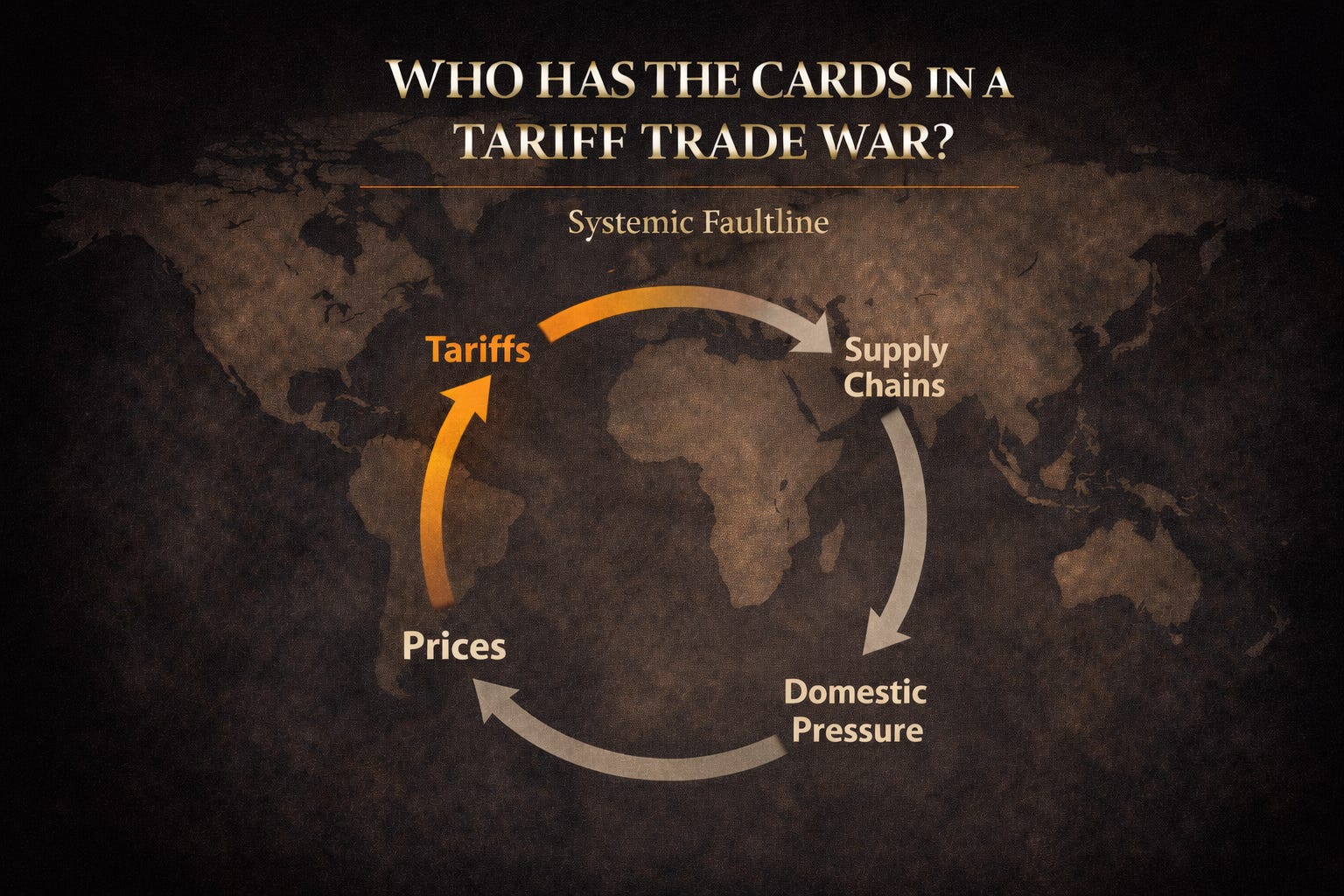
When politicians talk about tariffs, they talk as if power is obvious.
One side has leverage.
The other side does not.
Someone is bluffing. Someone will fold.
That framing is wrong in a way that matters.
Tariffs do not operate like leverage in a negotiation. They operate like stress in a system. They do not reveal who is strong. They reveal where dependence already exists.
That is the faultline most trade debates miss.
What tariffs actually do
A tariff does not land on a country.
It lands on a path.
It hits a supply chain, a pricing structure, a planning horizon. The effects then spread outward. Costs move. Delays appear. Margins shrink. Prices rise where they are most visible.
None of that stays neatly contained on one side of a border.
This is why tariff wars feel messy and unresolved. They are not contests of will. They are stress tests of interdependence.
Once you see tariffs this way, the “who has the cards” question changes.
The real question becomes: who can impose pressure that the system cannot quickly reroute, without triggering a domestic backlash that forces retreat?
What actually counts as leverage
In tariff conflicts, leverage comes from a small set of conditions:
How concentrated the supply path is
How long substitution takes
Where costs show up, quietly or publicly
How fast domestic pressure forces policy change
How precisely retaliation can be aimed
Leverage is not abstract. It is mechanical.
And it is always constrained.
The United States
The U.S. has leverage because access to its consumer market still matters. In sectors where exporters depend heavily on U.S. demand, tariffs create real pressure.
But that pressure feeds back quickly.
Tariffs raise costs that consumers and businesses notice. When that happens, exemptions appear. Timelines shift. The policy adapts because the system demands it.
Retaliation accelerates the feedback loop. Responses are designed to be politically loud, not economically clean.
The U.S. can apply pressure. It just cannot ignore where that pressure ends up.
China
China’s leverage comes from position, not consumption.
Large portions of global manufacturing still pass through Chinese production capacity. When that flow is disrupted, costs and delays spread outward, often hitting firms far removed from the tariff headline.
That is real leverage.
The constraint is time. Sustained disruption pushes companies to invest in alternatives. That process is slow, but once it begins, it does not reverse easily.
China can impose friction. The act of doing so slowly weakens the advantage.
The European Union
The EU’s strongest leverage is structural, not tactical.
Access to its market requires compliance with its standards. That quietly shapes production long before tariffs enter the conversation.
When the EU retaliates, it does so collectively. That allows pressure to be distributed across multiple sectors at once.
The limitation is speed. Internal coordination takes time, and trade exposure is high.
EU leverage constrains behavior more than it shocks it.
Canada
Canada shows why leverage is not about size.
Its economy is tightly integrated with the U.S. at the production level. Components cross borders as part of a single process. Disruption is felt immediately on both sides.
That creates sharp, targeted leverage.
The constraint is duration. Broad escalation hurts Canada faster than it hurts the U.S. Precision matters more than scale.
What this adds up to
Every major actor holds cards. None of them hold clean ones.
Tariffs are not weapons you point outward. They are loads you add to a shared structure. The structure responds where it is weakest, not where you intend.
That is why tariff wars do not end decisively. Pressure is applied. Pain spreads. Domestic constraints activate. Policies adjust. The cycle repeats.
The real leverage boundary
The dividing line is not who has the cards.
It is who can tolerate disorder longer without being forced to reverse course.
That is not strategy in the heroic sense. It is endurance inside a system that punishes anyone who believes they are in control.