
How to Think in Systems
And Why Many Explanations Miss the Point

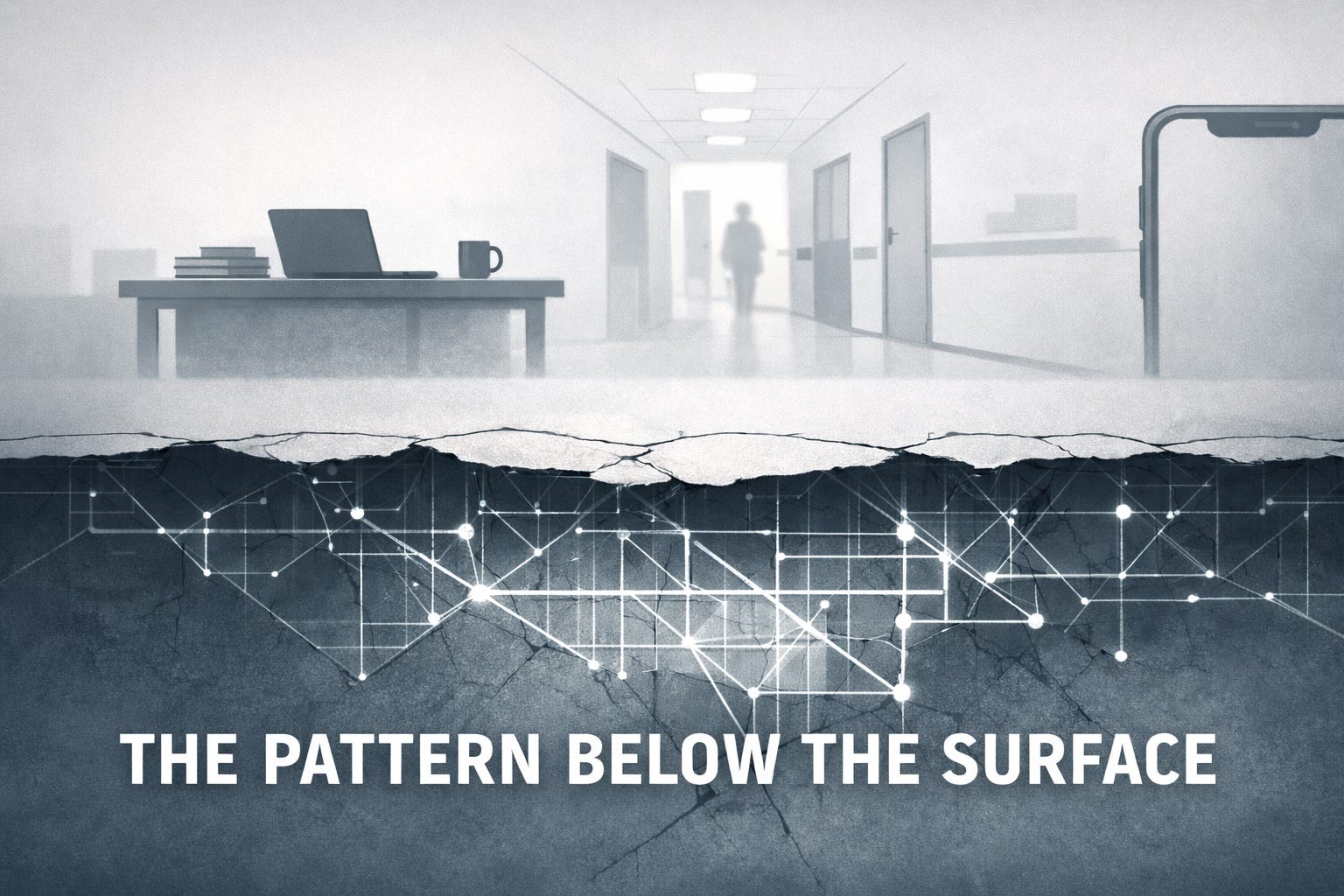
This piece is for people who keep noticing the same problems show up in different places and are tired of explanations that stop at blame, personality, or surface fixes. It is not a guide to solutions. It is a way of seeing what is already happening.
Why systems thinking matters in practice
Most people already live inside systems. They just encounter them at their worst moments.
A patient waits weeks for an appointment, then feels rushed once they finally get in the room. The problem is described as a careless provider or an inefficient clinic, even though every clinician in the building is moving as fast as they can.
A customer tries to cancel a subscription and runs into screens, delays, and retention prompts. The experience feels hostile, but no one person designed it to feel that way. It is the result of layered incentives around churn, growth, and engagement.
A teacher spends more time documenting learning than actually teaching. The issue is framed as paperwork overload or administrative bloat, while the deeper problem is that accountability has been tied to artifacts rather than outcomes.
In politics, voters swing between parties, personalities, and slogans, yet the same frustrations persist. Gridlock, performative outrage, and short term thinking are blamed on bad actors or moral failure. What is often missed is how incentives around elections, media cycles, fundraising, and institutional rules reward signaling over governing and conflict over resolution.
In each case, blaming individuals feels intuitive and satisfying. It also misses the point.
The behavior makes sense once you see the system producing it.
Most disagreements are about where the problem lives
Most public and workplace arguments are not really about values.
They are disagreements about where the problem lives.
One person points to bad decisions. Another points to bad leadership. Someone else blames policy, culture, technology, or incentives. Each explanation contains truth. None of them explains why the same outcomes keep repeating.
Systems thinking starts earlier than that. It asks a quieter question.
What structure keeps producing this outcome, even when people try to do better?
A system is not a collection of parts
It is common to describe a system as many things connected together. That description sounds reasonable, but it misses what matters.
A system is a pattern of behavior that persists over time.
If you replace the people and the outcome stays mostly the same, you are no longer dealing with individual performance or intent. You are dealing with structure.
This is why swapping leaders, retraining staff, or rewriting guidelines often feels productive at first and disappointing later. The system absorbs the change and continues.
People matter. Intent matters. Skill matters.
They just do not explain persistence.
How to start seeing systems without turning it into theory
You do not need diagrams or jargon to think in systems. You need to pay attention to a few recurring signals.
What behaviors repeat even when people change
Where pressure concentrates when something goes wrong
What gets rewarded quietly versus what gets praised publicly
What problems keep returning after being “fixed”
Who does extra work that rarely gets acknowledged
These are not steps. They are lenses. You can notice them in real time, often without anyone else pointing them out.
Systems reveal themselves under pressure
Most systems look fine when conditions are stable.
They show their real priorities when something goes wrong.
Watch what happens when demand spikes, time compresses, or resources thin. Notice who absorbs the extra work, which rules suddenly become rigid, and which goals quietly disappear.
Pressure does not create system behavior. It exposes it.
This is why crises feel clarifying in hindsight. They strip away the optional parts of the system and leave only what it actually runs on.
Incentives shape behavior more reliably than intent
When people say a system is broken, they usually mean the outcomes feel wrong.
But systems do not aim for outcomes. They respond to incentives.
If speed is rewarded, shortcuts appear.
If compliance is rewarded, paperwork grows.
If visibility is rewarded, performance shifts toward what can be seen.
When incentives conflict with stated values, incentives usually win. Not loudly. Just steadily.
This does not require bad people. It only requires people adapting to the environment they are in.
Feedback loops decide what sticks
The most important systems question is not what happened.
It is what happens next because this happened.
Look for loops:
Does effort reduce future workload, or does it create more of it?
Does fixing one problem remove pressure, or does it push that pressure somewhere else?
Does success stabilize the system, or does it attract more demand than the system can handle?
Some systems quietly punish the behaviors they claim to value. Others reward the behaviors they publicly criticize.
Once you see the dominant feedback loop, many confusing decisions stop being confusing.
Metrics change what they measure
Metrics are useful, but they are not neutral.
They compress reality into something countable, and that compression always drops context.
Once a metric becomes a target, behavior shifts toward its edges. People adapt to what is measured, not to what was intended.
When metrics replace judgment, systems drift toward performative compliance. When metrics replace understanding, appearance starts to matter more than function.
Systems do not fail randomly
When a system repeatedly produces inefficiency, burnout, or harm, it is usually doing exactly what its structure allows.
Calling this failure misses the point.
Systems succeed at what they are designed or incentivized to do, even when that success looks like dysfunction from the outside.
Understanding this does not excuse outcomes. It explains why surface fixes keep failing.
Why this way of thinking matters now
Without systems thinking, every problem turns into a morality story. Someone must be lazy, greedy, incompetent, or malicious.
With systems thinking, blame gives way to diagnosis.
This does not mean abandoning accountability. It means placing accountability where leverage actually exists.
Modern life is dominated by systems most people only encounter when something breaks. Administrative systems. Platform systems. Institutional systems. Algorithmic systems.
They shape daily life quietly, then become visible all at once.
What Systemic Faultline is about
Systemic Faultline exists to examine those moments.
It focuses on structure, incentives, constraints, and tradeoffs rather than villains or fixes. The goal is not to tell people what to do, but to make the mechanics visible enough to be understood.
If a system feels irrational, it usually is not. It is responding to pressures you have not been shown.
Seeing those pressures does not solve the problem.
But without that clarity, nothing else has much of a chance.